DevOps/SRE Career Path in 2026 - Salaries, Skills, Certifications and the Complete Career Ladder
Everything you need to know about building a career in DevOps, SRE, Platform Engineering, and Cloud Engineering. Real salary data, in-demand skills, certification ROI, interview prep, and job market analysis.
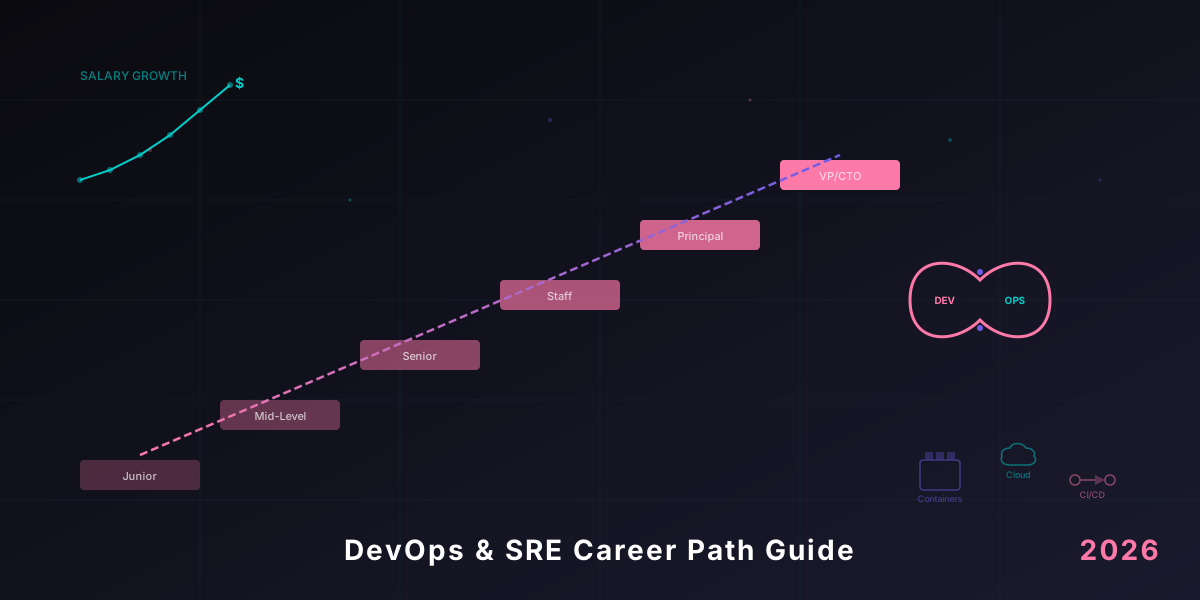
DevOps and SRE roles are among the highest-paid and most in-demand positions in tech
The infrastructure and operations side of software engineering has never been more lucrative or more confusing. In 2026, the lines between DevOps Engineer, Site Reliability Engineer, Platform Engineer, and Cloud Engineer are blurrier than ever. Job titles vary wildly between companies, salary ranges span from $83K to over $768K, and the skills landscape shifts every six months.
This guide cuts through the noise. We analyzed thousands of job postings, salary reports from Levels.fyi, Glassdoor, LinkedIn, and Indeed, plus hiring manager surveys and industry reports to give you the most complete picture of what a DevOps/SRE career actually looks like in 2026. Whether you are just starting out, considering a pivot, or negotiating your next promotion, this is the data you need.
Role Definitions - DevOps vs SRE vs Platform Engineer vs Cloud Engineer
Before we talk money and skills, let's clarify what these roles actually mean. The titles are used interchangeably at many companies, but there are real differences in focus, daily work, and career trajectory.
DevOps Engineer
The most common title in this space. DevOps Engineers focus on automating the software delivery pipeline from code commit to production deployment. They build and maintain CI/CD pipelines, manage infrastructure as code, configure monitoring and alerting, and work closely with development teams to improve deployment velocity and reliability.
- Primary Focus: CI/CD pipelines, infrastructure automation, deployment tooling
- Key Tools: Jenkins, GitHub Actions, GitLab CI, Terraform, Ansible, Docker, Kubernetes
- Reports To: Engineering Manager, VP of Engineering, or CTO
- Typical Team Size: 2-8 engineers embedded in or supporting development teams
Site Reliability Engineer (SRE)
Coined by Google in 2003, SRE applies software engineering principles to operations problems. SREs are responsible for the availability, latency, performance, efficiency, change management, monitoring, emergency response, and capacity planning of production systems. The key distinction from DevOps is the emphasis on SLOs (Service Level Objectives), error budgets, and toil reduction.
- Primary Focus: Reliability, SLOs/SLIs/SLAs, incident management, capacity planning
- Key Tools: Prometheus, Grafana, PagerDuty, Datadog, custom tooling in Python/Go
- Reports To: SRE Manager, Director of Infrastructure, VP of Engineering
- Typical Team Size: 3-12 engineers, often centralized with embedded rotations
Platform Engineer
The fastest-growing title in this space. Platform Engineers build Internal Developer Platforms (IDPs) that abstract away infrastructure complexity and give development teams self-service capabilities. Think of it as building a product, but your customers are other engineers inside your company.
- Primary Focus: Internal developer platforms, self-service tooling, developer experience
- Key Tools: Backstage, Crossplane, ArgoCD, custom portals, Kubernetes operators
- Reports To: Platform Engineering Manager, Director of Developer Experience
- Typical Team Size: 3-10 engineers, centralized team serving the entire engineering org
Cloud Engineer
Cloud Engineers focus specifically on designing, implementing, and managing cloud infrastructure. They are the specialists who understand the nuances of AWS, Azure, or GCP services and architect solutions that are cost-effective, secure, and scalable. In smaller companies, this role often overlaps entirely with DevOps.
- Primary Focus: Cloud architecture, networking, security, cost optimization
- Key Tools: AWS/Azure/GCP consoles and CLIs, CloudFormation/ARM/Deployment Manager, cloud-native services
- Reports To: Cloud Architecture Manager, Director of Infrastructure
- Typical Team Size: 2-6 engineers, often part of a larger infrastructure team
Role Comparison Table
| Attribute | DevOps Engineer | SRE | Platform Engineer | Cloud Engineer |
|---|---|---|---|---|
| Core Mission | Ship faster | Stay reliable | Empower developers | Optimize cloud |
| Primary Metric | Deployment frequency | SLO attainment | Developer satisfaction | Cost per workload |
| On-Call | Sometimes | Always | Rarely | Sometimes |
| Coding % | 30-50% | 50-70% | 60-80% | 20-40% |
| Avg. Salary (Mid) | $140-165K | $155-180K | $150-175K | $135-160K |
| Job Postings (2026) | Most common | Growing fast | Fastest growing | Stable |
| Best Entry Point | Junior DevOps | SWE or Ops background | Senior DevOps/SRE | Cloud support/admin |
Salary Data by Experience Level
Let's talk numbers. The following salary data is compiled from Levels.fyi, Glassdoor, LinkedIn Salary Insights, Indeed, Blind, and direct recruiter surveys. All figures represent total compensation (TC) in the United States, which includes base salary, stock grants/RSUs, and annual bonuses. Base salary alone is typically 60-75% of TC at senior levels and above.
Compensation by Level
| Level | Experience | Base Salary | Total Comp (TC) | Top-Tier TC |
|---|---|---|---|---|
| Junior / L3 | 0-2 years | $83,000 - $115,000 | $95,000 - $130,000 | $150,000 - $180,000 |
| Mid / L4 | 2-5 years | $115,000 - $155,000 | $130,000 - $180,000 | $200,000 - $260,000 |
| Senior / L5 | 5-8 years | $155,000 - $210,000 | $180,000 - $350,000 | $350,000 - $500,000 |
| Staff / L6 | 8-12 years | $190,000 - $260,000 | $220,000 - $450,000 | $450,000 - $650,000 |
| Principal / L7+ | 12+ years | $220,000 - $320,000 | $350,000 - $768,000+ | $600,000 - $1,000,000+ |
Sources: Levels.fyi (2026 data), Glassdoor, LinkedIn Salary Insights, Indeed, Blind salary threads. "Top-Tier TC" represents compensation at FAANG/MANGA companies, top-tier fintech, and well-funded late-stage startups.
Salary by Role Title
Even within the same experience level, the specific title affects compensation. SRE roles consistently pay a premium over generic DevOps titles, and Platform Engineering is catching up fast.
| Role Title | Median Base (Mid-Level) | Median TC (Mid-Level) | Median TC (Senior) |
|---|---|---|---|
| DevOps Engineer | $142,000 | $158,000 | $235,000 |
| Site Reliability Engineer | $158,000 | $178,000 | $290,000 |
| Platform Engineer | $152,000 | $172,000 | $275,000 |
| Cloud Engineer | $138,000 | $152,000 | $225,000 |
| Infrastructure Engineer | $145,000 | $162,000 | $248,000 |
| Release Engineer | $135,000 | $148,000 | $215,000 |
Compensation by Company Tier
| Company Tier | Examples | Senior TC Range | Staff TC Range |
|---|---|---|---|
| Tier 1 (FAANG+) | Google, Meta, Apple, Netflix, Amazon | $350K - $500K | $500K - $750K |
| Tier 2 (Top Tech) | Stripe, Databricks, Snowflake, Uber, Airbnb | $300K - $450K | $400K - $600K |
| Tier 3 (Strong Tech) | Datadog, HashiCorp, Cloudflare, Twilio | $250K - $380K | $350K - $500K |
| Tier 4 (Enterprise) | Banks, insurance, healthcare, retail | $180K - $280K | $220K - $350K |
| Tier 5 (Startups) | Seed to Series B startups | $160K - $250K + equity | $200K - $320K + equity |
Geographic Pay Differentials
Where you live (or where your employer is headquartered) has a massive impact on compensation. Cost-of-living adjustments, local talent competition, and state tax rates all factor in. Here's how the major US tech markets compare for DevOps/SRE roles in 2026.
Metro Area Pay Adjustments
| Metro Area | Pay Adjustment vs. National Avg. | Senior DevOps TC Range | Cost of Living Index | State Income Tax |
|---|---|---|---|---|
| San Francisco / Bay Area | +35% to +55% | $280K - $500K | 189 | Up to 13.3% |
| Seattle / Puget Sound | +20% to +35% | $240K - $420K | 162 | 0% (no state income tax) |
| New York City | +20% to +35% | $240K - $400K | 187 | Up to 10.9% + NYC tax |
| Austin, TX | +5% to +15% | $195K - $320K | 112 | 0% (no state income tax) |
| Denver / Boulder | +5% to +12% | $190K - $310K | 118 | 4.4% flat |
| Remote (US-based) | -8% to -12% | $170K - $300K | Varies | Varies by state |
Cost of Living Index: 100 = US national average. Sources: Bureau of Labor Statistics, Numbeo, Levels.fyi geographic data.
Effective Take-Home Comparison (Senior Level, $300K TC)
| City | Gross TC | Federal + State Tax | Approx. Take-Home | Median Rent (2BR) | After Rent |
|---|---|---|---|---|---|
| San Francisco | $300,000 | ~$95,000 | ~$205,000 | $4,200/mo | ~$154,600 |
| Seattle | $300,000 | ~$78,000 | ~$222,000 | $3,100/mo | ~$184,800 |
| New York City | $300,000 | ~$100,000 | ~$200,000 | $4,500/mo | ~$146,000 |
| Austin | $270,000 | ~$70,000 | ~$200,000 | $2,200/mo | ~$173,600 |
| Denver | $265,000 | ~$73,000 | ~$192,000 | $2,400/mo | ~$163,200 |
| Remote (from low-COL) | $255,000 | ~$66,000 | ~$189,000 | $1,500/mo | ~$171,000 |
Most In-Demand Skills
We analyzed over 15,000 DevOps, SRE, Platform Engineering, and Cloud Engineering job postings from January through April 2026 across LinkedIn, Indeed, Glassdoor, and company career pages. Here's what employers are actually asking for, ranked by frequency of appearance in job postings.
Top Skills by Job Posting Frequency
| Rank | Skill | % of Postings | Trend (YoY) | Category |
|---|---|---|---|---|
| 1 | Kubernetes | 70% | 📈 +8% | Orchestration |
| 2 | AWS | 68% | 📊 Stable | Cloud |
| 3 | Terraform | 65% | 📈 +5% | IaC |
| 4 | Python | 64.7% | 📈 +3% | Programming |
| 5 | CI/CD (GitHub Actions, GitLab CI, Jenkins) | 62% | 📈 +6% | Automation |
| 6 | Docker | 60% | 📉 -2% | Containers |
| 7 | Linux | 58% | 📊 Stable | OS |
| 8 | Go | 42% | 📈 +12% | Programming |
| 9 | Observability (Prometheus, Grafana, Datadog) | 41% | 📈 +15% | Monitoring |
| 10 | Azure | 38% | 📈 +4% | Cloud |
| 11 | ArgoCD / GitOps | 35% | 📈 +18% | Deployment |
| 12 | Bash/Shell Scripting | 34% | 📉 -3% | Scripting |
| 13 | GCP | 22% | 📈 +2% | Cloud |
| 14 | Ansible | 20% | 📉 -8% | Config Mgmt |
Key Takeaways
Kubernetes is king. Appearing in 70% of all DevOps/SRE job postings, Kubernetes knowledge is no longer optional. It's the baseline expectation. If you don't know Kubernetes, you are limiting yourself to a shrinking pool of roles.
Go is the fastest-growing language. Go (Golang) jumped 12% year-over-year in job postings. It's the language of cloud-native infrastructure (Kubernetes, Docker, Terraform, Prometheus are all written in Go), and employers increasingly want engineers who can contribute to or extend these tools.
GitOps is exploding. ArgoCD and Flux-based GitOps workflows saw an 18% increase in job postings. The shift from imperative CI/CD (Jenkins pipelines that push changes) to declarative GitOps (ArgoCD that pulls desired state from Git) is accelerating.
Observability is the new monitoring. The shift from basic monitoring (is it up or down?) to full observability (metrics, logs, traces, and profiling) is driving demand for engineers who understand distributed tracing, OpenTelemetry, and modern observability platforms.
Ansible is declining. Configuration management tools like Ansible, Chef, and Puppet are losing ground to immutable infrastructure patterns (containers + Kubernetes) and infrastructure as code (Terraform). Ansible still has a place for bare-metal and legacy environments, but it's no longer a must-have skill.
Programming Language Breakdown
| Language | % of Postings | Primary Use Case | Salary Premium |
|---|---|---|---|
| Python | 64.7% | Automation, scripting, tooling, Lambda functions | Baseline (expected) |
| Go | 42% | CLI tools, Kubernetes operators, high-performance services | +8-15% |
| Bash | 34% | Shell scripts, system administration, quick automation | Baseline (expected) |
| Rust | 12% | Performance-critical tooling, systems programming | +15-25% |
| TypeScript | 11% | CDK, Pulumi, internal tooling UIs | Neutral |
Certification Impact on Salary
Certifications in the DevOps/SRE space are a nuanced topic. Unlike security roles (where CISSP or Security+ can be mandatory), infrastructure certifications are rarely required. But they do move the needle on compensation, especially at the junior and mid levels, and they are increasingly used as tiebreakers in competitive hiring processes.
Certification ROI Table
| Certification | Exam Cost | Study Time | Salary Premium | ROI Rating |
|---|---|---|---|---|
| AWS Solutions Architect Professional | $300 | 8-12 weeks | +$15,000 - $20,000 | ⭐⭐⭐⭐⭐ |
| CKA (Certified Kubernetes Administrator) | $395 | 6-10 weeks | +$10,000 - $20,000 | ⭐⭐⭐⭐⭐ |
| Terraform Associate | $70 | 2-3 weeks | +$8,000 - $15,000 | ⭐⭐⭐⭐⭐ (Best ROI) |
| AWS DevOps Engineer Professional | $300 | 8-10 weeks | +$12,000 - $18,000 | ⭐⭐⭐⭐ |
| CKAD (Kubernetes Application Developer) | $395 | 4-8 weeks | +$8,000 - $15,000 | ⭐⭐⭐⭐ |
| AWS Solutions Architect Associate | $150 | 4-8 weeks | +$8,000 - $12,000 | ⭐⭐⭐⭐ |
| CKS (Kubernetes Security Specialist) | $395 | 6-8 weeks | +$10,000 - $18,000 | ⭐⭐⭐⭐ |
| GitHub Actions | $99 | 1-2 weeks | +$3,000 - $8,000 | ⭐⭐⭐ |
| Azure DevOps Engineer Expert (AZ-400) | $165 | 6-8 weeks | +$10,000 - $15,000 | ⭐⭐⭐⭐ |
When Certifications Matter Most
- Career changers: Moving from sysadmin, help desk, or development into DevOps? Certifications provide credible proof of your new skills.
- Junior engineers (0-3 years): When you lack experience, certifications fill the gap and get you past ATS filters.
- Consulting and MSP roles: AWS/Azure partner companies often require certified staff to maintain their partner tier.
- Government and defense: DoD 8140 mandates specific certifications for certain roles.
When Certifications Matter Less
- Senior+ engineers with strong track records: At the senior level and above, your experience, system design skills, and references matter far more than certifications.
- FAANG interviews: Google, Meta, and similar companies don't care about certifications. They evaluate through rigorous technical interviews.
- Open-source contributors: If you have meaningful contributions to Kubernetes, Terraform, or Prometheus, that speaks louder than any cert.
Career Progression Ladder
Understanding the career ladder helps you set realistic expectations and plan your growth. Here's what each level looks like in terms of scope, expectations, and timeline. These levels roughly map to the standard engineering ladder used at most tech companies (L3-L7+).
Junior DevOps/SRE (L3) - 0 to 2 Years
Scope: Individual tasks within a well-defined system. You are given specific tickets and work under close guidance from senior engineers.
- Write and maintain CI/CD pipeline configurations
- Create and update Terraform modules with code review
- Respond to alerts during on-call rotations (with senior backup)
- Write runbooks and documentation
- Automate repetitive tasks with Python or Bash scripts
- Participate in incident response as an observer or note-taker
What gets you promoted: Consistently delivering assigned tasks on time, showing initiative to automate toil, writing clear documentation, and demonstrating you can handle on-call without escalating everything.
Mid-Level DevOps/SRE (L4) - 2 to 5 Years
Scope: Owning features and small systems end-to-end. You can take a problem statement and deliver a solution with minimal guidance.
- Design and implement CI/CD pipelines for new services
- Own the reliability of specific services or components
- Lead incident response for your area of ownership
- Mentor junior engineers and review their code
- Propose and implement infrastructure improvements
- Participate in architecture discussions and on-call rotations independently
What gets you promoted: Demonstrating ownership and technical judgment. You should be able to identify problems before they become incidents, propose solutions that consider tradeoffs, and influence your team's technical direction.
Senior DevOps/SRE (L5) - 5 to 8 Years
Scope: Owning large systems or multiple services. You set technical direction for your team and influence adjacent teams.
- Design infrastructure architecture for new products or major features
- Define SLOs, error budgets, and reliability standards
- Lead post-incident reviews and drive systemic improvements
- Mentor mid-level engineers and help them grow to senior
- Make build-vs-buy decisions for infrastructure tooling
- Represent infrastructure in cross-functional planning
- Write technical design documents and RFCs
What gets you promoted: Impact beyond your immediate team. Staff-level promotion requires demonstrating that your work improves the productivity or reliability of the broader engineering organization, not just your own team.
Staff DevOps/SRE (L6) - 8 to 12 Years
Scope: Organization-wide impact. You define technical strategy across multiple teams and drive initiatives that affect the entire engineering org.
- Define the infrastructure strategy and technology roadmap for the organization
- Lead multi-quarter, cross-team infrastructure initiatives
- Establish engineering standards, best practices, and review processes
- Serve as the technical escalation point for the most complex incidents
- Influence hiring standards and interview processes
- Partner with engineering leadership on capacity planning and budget
- Represent the company at conferences and in the broader community
What gets you promoted: Company-wide or industry-level impact. Principal engineers typically shape the technical direction of the entire company, contribute to open-source projects that the industry depends on, or solve problems that nobody else in the organization can solve.
Principal DevOps/SRE (L7+) - 12+ Years
Scope: Company-wide or industry-wide impact. You are one of the top technical leaders in the organization.
- Set the multi-year technical vision for infrastructure
- Make decisions that affect hundreds of engineers and millions of users
- Represent the company in industry standards bodies and open-source governance
- Advise executive leadership on technical strategy and risk
- Solve the hardest, most ambiguous technical problems in the organization
- Build and maintain relationships with peer principals across the industry
Career Ladder Summary
| Level | Years | Scope of Impact | TC Range | % Who Reach This Level |
|---|---|---|---|---|
| Junior (L3) | 0-2 | Individual tasks | $95K - $130K | 100% (entry point) |
| Mid (L4) | 2-5 | Features / small systems | $130K - $180K | ~85% |
| Senior (L5) | 5-8 | Large systems / team | $180K - $350K | ~50% |
| Staff (L6) | 8-12 | Organization | $220K - $450K | ~10-15% |
| Principal (L7+) | 12+ | Company / industry | $350K - $768K+ | ~2-5% |
IC vs. Management Track
At the Senior level, you face a fork in the road: continue on the Individual Contributor (IC) track toward Staff and Principal, or switch to the Management track as an Engineering Manager.
| Attribute | IC Track (Staff/Principal) | Management Track (EM/Director) |
|---|---|---|
| Daily Work | Technical design, coding, architecture | 1:1s, planning, hiring, performance reviews |
| Coding Time | 30-60% | 0-20% |
| Compensation | Comparable at each level | Comparable at each level |
| Availability | Fewer positions, harder to find | More positions, more companies |
| Best For | Deep technical experts who love solving hard problems | People who enjoy growing others and organizational impact |
The Interview Process
DevOps and SRE interviews are notoriously varied. Unlike software engineering interviews (which have converged on a fairly standard format), infrastructure interviews differ significantly between companies. Here's what to expect across the industry in 2026.
Typical Interview Pipeline
Most companies run 4 to 6 rounds for DevOps/SRE roles. The process typically takes 2-4 weeks from first contact to offer.
| Round | Format | Duration | What They Evaluate |
|---|---|---|---|
| 1. Recruiter Screen | Phone/Video call | 30 min | Culture fit, salary expectations, role alignment, visa status |
| 2. Technical Screen | Phone/Video with engineer | 45-60 min | Linux fundamentals, networking, basic coding, tool knowledge |
| 3. System Design | Whiteboard/Virtual | 60 min | Architecture design, scalability, reliability, tradeoff analysis |
| 4. Coding Round | Live coding or take-home | 60-90 min | Python/Go/Bash scripting, automation, data structures |
| 5. Incident Response | Scenario-based | 45-60 min | Debugging, troubleshooting, communication under pressure |
| 6. Behavioral/Values | Panel or 1:1 | 45 min | Leadership, collaboration, conflict resolution, past experiences |
System Design - The Make-or-Break Round
The system design round is where most candidates succeed or fail at the senior level and above. You will be asked to design a system from scratch or improve an existing architecture. Common prompts include:
- "Design a CI/CD pipeline for a microservices architecture with 50 services" - Tests your knowledge of build systems, artifact management, deployment strategies (blue-green, canary), and rollback mechanisms.
- "Design a monitoring and alerting system for a global e-commerce platform" - Tests your understanding of metrics collection, log aggregation, distributed tracing, SLOs, and alert routing.
- "Design the infrastructure for a multi-region, highly available application" - Tests your knowledge of DNS, load balancing, database replication, failover strategies, and disaster recovery.
- "How would you migrate a monolithic application to Kubernetes?" - Tests your understanding of containerization, service decomposition, networking, storage, and migration strategies.
Coding Round - What to Expect
DevOps/SRE coding rounds are different from software engineering interviews. You won't typically face LeetCode-style algorithm questions (though some companies like Google still include them for SRE). Instead, expect:
- Scripting tasks: Parse a log file, extract metrics, generate a report. Usually in Python or Bash.
- Automation tasks: Write a script that provisions infrastructure, deploys an application, or performs a health check.
- API interaction: Write code that interacts with a REST API, processes JSON responses, and handles errors.
- Data structures: Basic knowledge of lists, dictionaries, sets, and when to use each. No red-black trees or dynamic programming.
- Terraform/IaC: Some companies ask you to write Terraform configurations or Kubernetes manifests live.
Incident Response Round
This is unique to SRE and DevOps interviews. You will be presented with a production incident scenario and asked to walk through your debugging process. The interviewer evaluates:
- Systematic approach: Do you follow a logical debugging process, or do you jump to conclusions?
- Communication: Can you clearly articulate what you are doing and why?
- Tool knowledge: Do you know which tools to use for different types of problems?
- Prioritization: Do you focus on mitigation first (restore service) before root cause analysis?
- Escalation judgment: Do you know when to escalate and when to keep investigating?
Interview Prep Resources
- Google SRE Book (Free) - The definitive resource on SRE practices. Read chapters on SLOs, monitoring, incident response, and toil.
- System Design Primer (Free) - Comprehensive system design study guide on GitHub.
- Grokking System Design - Paid course with infrastructure-focused design problems.
- SadServers (Free) - Practice Linux troubleshooting scenarios in a browser. Perfect for incident response prep.
Day-in-the-Life by Level
Job descriptions are abstract. Here's what each level actually does on a typical day. These are composites based on interviews with engineers at various levels across multiple companies.
Junior DevOps Engineer - A Typical Tuesday
| Time | Activity |
|---|---|
| 9:00 AM | Check Slack for overnight alerts. Review the on-call handoff notes from the night shift. |
| 9:30 AM | Daily standup with the team. Pick up a Jira ticket to add a new microservice to the CI/CD pipeline. |
| 10:00 AM | Write a GitHub Actions workflow for the new service. Reference existing workflows as templates. |
| 11:30 AM | Open a PR. Senior engineer reviews it and suggests improvements to the caching strategy. |
| 12:00 PM | Lunch break. |
| 1:00 PM | Address PR feedback. Learn about GitHub Actions cache actions in the process. |
| 2:00 PM | Pair with a senior engineer to debug a flaky integration test in the staging environment. |
| 3:30 PM | Write a runbook for the new service's deployment process. |
| 4:30 PM | Study for CKA certification (company-sponsored). Work through KodeKloud labs. |
| 5:30 PM | End of day. Update Jira tickets with progress notes. |
Mid-Level SRE - A Typical Wednesday
| Time | Activity |
|---|---|
| 8:30 AM | On-call this week. Check dashboards and overnight alerts. One alert fired at 3 AM but auto-resolved. |
| 9:00 AM | Team standup. Report on the overnight alert and propose a fix to reduce false positives. |
| 9:30 AM | Work on a Terraform module to standardize database provisioning across teams. |
| 11:00 AM | Review a junior engineer's PR for a new Prometheus alerting rule. Provide detailed feedback. |
| 11:30 AM | Incident! The payment service is returning elevated 5xx errors. Lead the incident response. |
| 12:15 PM | Incident mitigated by rolling back a bad config change. Write up the initial incident summary. |
| 12:30 PM | Late lunch. |
| 1:30 PM | Post-incident review meeting. Identify action items to prevent recurrence. |
| 2:30 PM | Back to the Terraform module. Write tests using Terratest. |
| 4:00 PM | 1:1 with manager. Discuss career growth and upcoming projects. |
| 4:30 PM | Review SLO dashboard. The checkout service is burning error budget faster than expected. File a ticket. |
| 5:30 PM | End of day. Hand off on-call context to the secondary. |
Senior Platform Engineer - A Typical Thursday
| Time | Activity |
|---|---|
| 9:00 AM | Review overnight PRs from the team. Approve two, request changes on one. |
| 9:30 AM | Work on the internal developer portal (Backstage). Adding a new template for spinning up microservices with one click. |
| 11:00 AM | Architecture review meeting. Present a design doc for migrating from Jenkins to ArgoCD for GitOps deployments. |
| 12:00 PM | Lunch with a product team. Gather feedback on the developer platform's pain points. |
| 1:00 PM | Write a technical RFC for a new self-service database provisioning feature. |
| 3:00 PM | Mentor a mid-level engineer on Kubernetes operator development. |
| 4:00 PM | Sprint planning for next week. Prioritize platform features based on developer survey results. |
| 5:00 PM | Respond to questions in the #platform-support Slack channel. |
| 5:30 PM | End of day. |
Staff SRE - A Typical Friday
| Time | Activity |
|---|---|
| 9:00 AM | Weekly reliability review with engineering leadership. Present SLO attainment across all services. |
| 10:00 AM | Work on a proposal to adopt OpenTelemetry across the organization. This is a multi-quarter initiative. |
| 11:30 AM | Interview a senior SRE candidate. Conduct the system design round. |
| 12:30 PM | Lunch. |
| 1:30 PM | Cross-team meeting with the data platform team. Align on shared infrastructure for the ML pipeline. |
| 2:30 PM | Code review for a critical change to the service mesh configuration. |
| 3:30 PM | Write a blog post for the engineering blog about the recent database migration project. |
| 4:30 PM | Prepare slides for a conference talk next month on scaling Kubernetes to 5,000 nodes. |
| 5:30 PM | End of day. Start the weekend. |
Remote Work Landscape
The remote work situation for DevOps and SRE roles in 2026 is more nuanced than the binary "remote vs. office" debate suggests. The pandemic-era fully-remote experiment has largely settled into a hybrid equilibrium, but infrastructure roles have some unique dynamics.
The Numbers
| Work Model | % of DevOps/SRE Roles | Trend |
|---|---|---|
| Hybrid (2-3 days in office) | 70% | 📈 Increasing (was 55% in 2024) |
| Fully Remote | 20% | 📉 Decreasing (was 35% in 2024) |
| Fully On-Site | 10% | 📊 Stable |
Despite the shift toward hybrid, 80% of DevOps/SRE professionals work from home at least partially. The nature of infrastructure work (managing cloud resources, writing code, responding to alerts) is inherently remote-friendly. The push for in-office time is driven more by company culture and management preferences than by the technical requirements of the role.
Companies That Are Still Fully Remote
- GitLab - All-remote since founding. 2,000+ employees across 65+ countries. Transparent handbook.
- Automattic (WordPress.com) - Fully distributed. 1,900+ employees. No offices.
- Zapier - Fully remote. 800+ employees. Known for strong remote culture.
- Grafana Labs - Remote-first. Building the open-source observability stack.
- Elastic - Distributed since founding. Elasticsearch, Kibana, Logstash.
- HashiCorp - Remote-first. Makers of Terraform, Vault, Consul.
Companies Requiring Return-to-Office
- Amazon - 5 days/week in office as of January 2025. Significant attrition resulted.
- Google - 3 days/week hybrid. Remote exceptions are rare and require VP approval.
- Meta - 3 days/week hybrid. Some fully remote roles still exist.
- Apple - 3 days/week hybrid. Strictest of the big tech companies after Amazon.
- Most banks and financial institutions - 3-5 days/week. Compliance and security concerns drive in-office requirements.
Remote Work Impact on Compensation
| Scenario | Pay Impact | Notes |
|---|---|---|
| Remote, same metro as HQ | 0% to -5% | Some companies pay the same, others apply a small discount |
| Remote, high-COL city | 0% to -8% | Usually pegged to local market rates |
| Remote, low-COL area | -8% to -12% | Geographic pay bands apply at most large companies |
| Remote, international | -20% to -50% | Significant discount for non-US locations, even for US companies |
Emerging Specializations
The DevOps/SRE field is fragmenting into increasingly specialized sub-disciplines. These emerging specializations command salary premiums because demand far outstrips supply. If you are looking for a way to differentiate yourself and maximize compensation, these are the areas to watch.
MLOps Engineer
Salary Premium: +30% to +60% over standard DevOps
MLOps engineers bridge the gap between data science and production infrastructure. They build and maintain the pipelines that train, deploy, monitor, and retrain machine learning models at scale. With every company racing to deploy AI, MLOps engineers are in extreme demand.
- Key Skills: Kubernetes, ML frameworks (PyTorch, TensorFlow), model serving (Triton, TorchServe, vLLM), feature stores, experiment tracking (MLflow, Weights & Biases), GPU infrastructure
- Typical TC (Senior): $280,000 - $500,000
- Growth Rate: 85% increase in job postings year-over-year
- Best Entry Path: DevOps/SRE experience + ML fundamentals, or data engineering + infrastructure skills
FinOps Engineer
Salary Premium: +15% to +30% over standard DevOps
FinOps (Financial Operations) engineers optimize cloud spending across the organization. As cloud bills grow into the millions, companies are creating dedicated roles to manage and reduce costs. FinOps combines infrastructure knowledge with financial analysis and business communication skills.
- Key Skills: Cloud cost management tools (AWS Cost Explorer, CloudHealth, Kubecost), reserved instance/savings plan optimization, showback/chargeback models, FinOps Framework
- Typical TC (Senior): $220,000 - $380,000
- Growth Rate: 45% increase in job postings year-over-year
- Best Entry Path: Cloud engineering + financial analysis skills, or DevOps + strong communication skills
DevSecOps Engineer
Salary Premium: +20% to +40% over standard DevOps
DevSecOps engineers integrate security into every stage of the software delivery pipeline. They implement shift-left security practices, manage vulnerability scanning, enforce policy-as-code, and ensure compliance in automated environments.
- Key Skills: SAST/DAST tools (Snyk, SonarQube, Trivy), policy-as-code (OPA, Kyverno), secrets management (Vault, AWS Secrets Manager), supply chain security (Sigstore, SBOM), compliance frameworks
- Typical TC (Senior): $240,000 - $420,000
- Growth Rate: 55% increase in job postings year-over-year
- Best Entry Path: DevOps + security certifications (CKS, AWS Security Specialty), or security engineering + infrastructure skills
Platform Engineer
Salary Premium: +10% to +25% over standard DevOps
As discussed in the role definitions section, Platform Engineering is the fastest-growing specialization. It's evolving from a subset of DevOps into a distinct discipline with its own tools, practices, and career ladder. Gartner predicts that by 2027, 80% of large software engineering organizations will have established platform engineering teams.
- Key Skills: Backstage, Crossplane, Kubernetes operators, API design, developer experience (DX), internal tooling
- Typical TC (Senior): $230,000 - $400,000
- Growth Rate: 70% increase in job postings year-over-year
- Best Entry Path: Senior DevOps/SRE with a passion for developer experience and product thinking
Specialization Comparison
| Specialization | Salary Premium | Demand Growth | Entry Difficulty | Longevity Outlook |
|---|---|---|---|---|
| MLOps | +30-60% | 🔥🔥🔥🔥🔥 | High (needs ML + infra) | 10+ years |
| DevSecOps | +20-40% | 🔥🔥🔥🔥 | Medium (needs security knowledge) | 10+ years |
| Platform Engineering | +10-25% | 🔥🔥🔥🔥🔥 | Medium (needs product thinking) | 10+ years |
| FinOps | +15-30% | 🔥🔥🔥 | Medium (needs financial skills) | 5-10 years |
Job Market Data
The DevOps/SRE job market in 2026 is one of the strongest in all of tech. While other areas of software engineering have seen hiring slowdowns and layoffs, infrastructure roles have remained resilient. Here's the data.
Market Overview
| Metric | 2024 | 2025 | 2026 (Current) | Trend |
|---|---|---|---|---|
| Open DevOps/SRE Roles (US) | ~85,000 | ~105,000 | ~150,000 | 📈 +43% YoY |
| Unfilled Infrastructure Positions (Global) | ~800,000 | ~1,000,000 | ~1,200,000 | 📈 +20% YoY |
| Unemployment Rate (DevOps/SRE) | 2.1% | 1.8% | <2% | 📉 Near zero |
| Avg. Time to Fill (Days) | 42 | 48 | 52 | 📈 Harder to hire |
| Avg. Applications per Role | 85 | 110 | 130 | 📈 More competitive |
Sources: LinkedIn Workforce Report, Indeed Hiring Lab, Bureau of Labor Statistics, Dice Tech Salary Report, CompTIA State of the Tech Workforce.
Why the Market Is So Strong
Several converging trends are driving the sustained demand for DevOps/SRE talent:
- AI infrastructure buildout: Every company deploying AI models needs infrastructure engineers to manage GPU clusters, ML pipelines, and model serving infrastructure. This alone accounts for a significant portion of the 43% surge in open roles.
- Cloud migration continues: Despite years of cloud adoption, only ~30% of enterprise workloads have migrated to the cloud. The remaining 70% represents years of continued demand for cloud and infrastructure engineers.
- Kubernetes complexity: Kubernetes adoption is near-universal, but operating it at scale requires specialized expertise. The gap between "we deployed Kubernetes" and "we operate Kubernetes reliably" is where SREs and platform engineers live.
- Security and compliance pressure: Increasing regulatory requirements (SOC 2, HIPAA, PCI-DSS, GDPR) are driving demand for engineers who can build compliant infrastructure and automate security controls.
- Platform engineering movement: The shift toward internal developer platforms is creating an entirely new category of roles that didn't exist five years ago.
Job Market by Industry
| Industry | Hiring Velocity | Avg. TC (Senior) | Remote Availability |
|---|---|---|---|
| AI/ML Companies | 🔥🔥🔥🔥🔥 | $350K - $550K | Medium (hybrid preferred) |
| Fintech | 🔥🔥🔥🔥 | $280K - $450K | Medium (hybrid) |
| Cloud/SaaS | 🔥🔥🔥🔥 | $260K - $420K | High (many remote-first) |
| Healthcare Tech | 🔥🔥🔥 | $220K - $350K | Medium |
| E-commerce | 🔥🔥🔥 | $230K - $380K | Medium |
| Government/Defense | 🔥🔥🔥 | $180K - $280K | Low (clearance often required) |
| Consulting | 🔥🔥🔥 | $200K - $340K | Medium (client-dependent) |
Where the Jobs Are (Top Hiring Companies, Q1 2026)
Based on LinkedIn job posting data, these companies had the most open DevOps/SRE/Platform Engineering roles in Q1 2026:
- Amazon/AWS - 2,800+ open infrastructure roles
- Google/Alphabet - 1,500+ open SRE and infrastructure roles
- Microsoft/Azure - 1,400+ open cloud and DevOps roles
- Meta - 800+ open production engineering roles
- JPMorgan Chase - 600+ open cloud and DevOps roles
- Capital One - 500+ open cloud engineering roles
- Datadog - 350+ open SRE and infrastructure roles
- Stripe - 300+ open infrastructure roles
- Snowflake - 280+ open SRE roles
- Databricks - 250+ open platform engineering roles
Breaking In - Realistic Paths
If you are trying to break into DevOps/SRE from another role, here are the most common and successful transition paths:
| Current Role | Transition Difficulty | Timeline | Key Steps |
|---|---|---|---|
| Software Engineer | ⭐⭐ (Easiest) | 3-6 months | Learn Kubernetes, Terraform, CI/CD. Apply for SRE roles. |
| System Administrator | ⭐⭐⭐ (Moderate) | 6-12 months | Learn coding (Python), IaC, containers. Get AWS SAA cert. |
| Network Engineer | ⭐⭐⭐ (Moderate) | 6-12 months | Learn cloud networking, Terraform, Kubernetes. Leverage networking expertise. |
| Help Desk / IT Support | ⭐⭐⭐⭐ (Hard) | 12-18 months | Learn Linux, scripting, cloud fundamentals. Get certs. Build projects. |
| Career Changer (Non-Tech) | ⭐⭐⭐⭐⭐ (Hardest) | 18-24 months | Start with Linux, networking basics. Bootcamp or self-study. Build portfolio. |
The Bottom Line
DevOps, SRE, and Platform Engineering represent some of the most lucrative and in-demand career paths in technology in 2026. With salaries ranging from $83K at the junior level to over $768K at the principal level, a sub-2% unemployment rate, and 1.2 million unfilled positions globally, the market fundamentals are overwhelmingly in your favor.
The key to maximizing your career in this space: pick a specialization (MLOps, DevSecOps, or Platform Engineering for the highest premiums), invest in high-ROI certifications (Terraform Associate, CKA, AWS SA Pro), build real projects that demonstrate your skills, and negotiate aggressively on total compensation, not just base salary.
Start today. The demand isn't slowing down.